La Palma Beaches: Black-Sand Guide to the Best Bays
La Palma's beaches are black volcanic sand, from family-friendly Tazacorte and snorkelling at Los Cancajos to remote Nogales and the seawater pools at Charco Azul.
On this page
La Palma rewards travellers who treat the beach as part of a day out rather than the whole of it. The island's volcanic origins give almost every bay dark sand, and the coastline ranges from long resort beaches with promenades and lifeguards to cliff-foot coves reached by long staircases.
The practical choice is usually between coasts. The west around Puerto Naos and Tazacorte has the facilities, the sunset and the accommodation; the east around Los Cancajos and Santa Cruz faces a different swell and often offers calmer water when the west is exposed. Pick the coast to match the forecast, then the beach to match your group.
Why La Palma's beaches are black
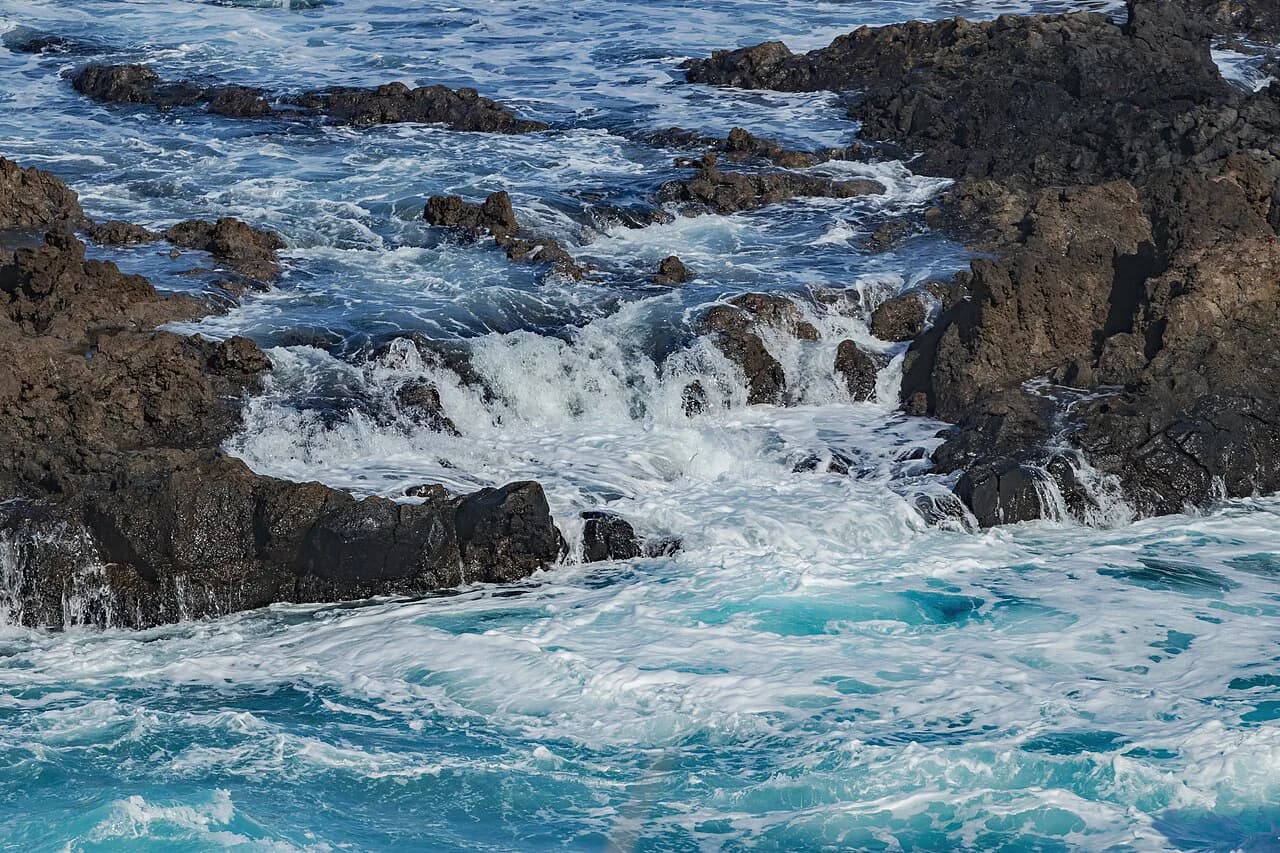
The sand is dark because the island is volcanic, not because it is dirty, and it varies from fine black sand to pebbles and bare rock depending on the cove. That matters for planning: shingle and rock hold their footing better than soft sand on a steep slope, but they are harder on bare feet, so bring reef shoes for the cliff beaches.
The 2021 Tajogaite eruption reshaped parts of the west coast. Puerto Naos reopened to the public in 2024 and remains under permanent CO₂ monitoring, while the former Los Guirres beach between Tazacorte and Puerto Naos was covered by lava and is no longer a bathing beach; the new lava delta is under scientific observation and must not be entered without authorisation.
Treat beach flags as the final word on any given day. Yellow signals dangerous waves or currents, red means swimming is prohibited and green indicates favourable conditions, and lifeguard instructions take priority over anything a guide written months earlier says.
West coast: Puerto Naos and Tazacorte
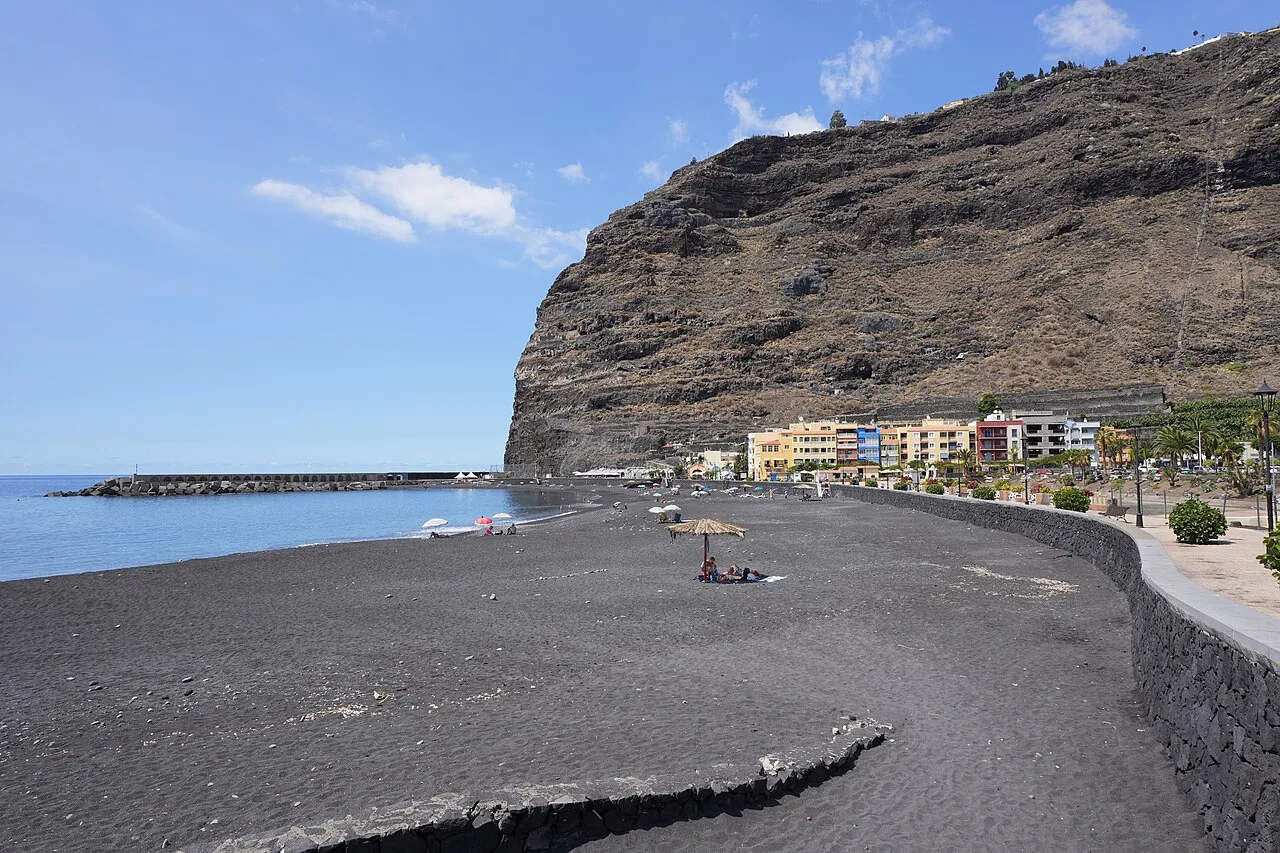
Puerto Naos is the island's best-known west-coast beach, a black-sand bay with olivine crystals that give the sand a greenish tint in places. Palm trees provide shade and a seafront promenade links the beach to restaurants, terraces and accommodation, with much of the access suitable for visitors with reduced mobility.
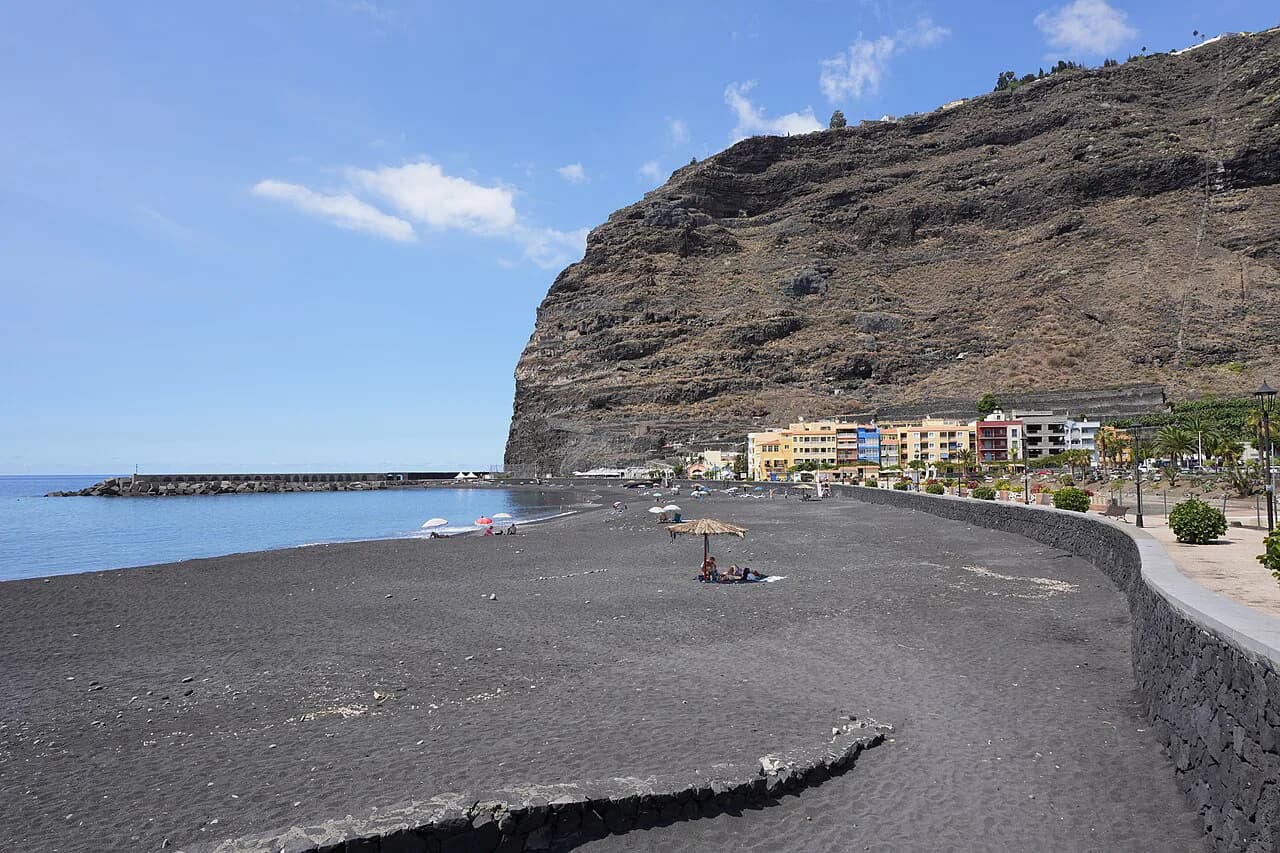
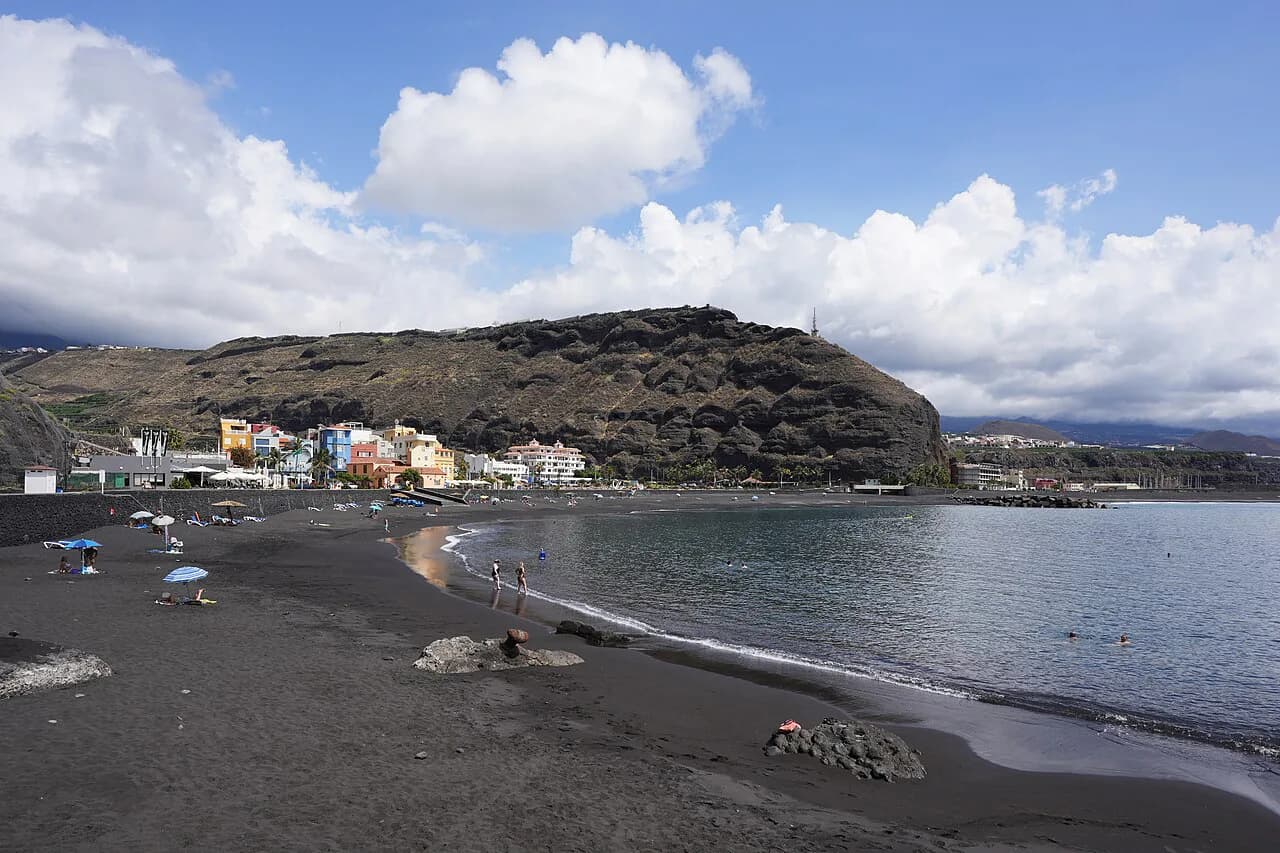
Tazacorte, at the mouth of the Barranco de las Angustias, is one of the longest black-sand beaches on the island, and a breakwater cuts down the currents and waves that reach the shore. That shelter makes it the default choice for families on the west coast, and the promenade behind it carries bars, cafés and accessible entrances, with parking and a bus stop close by.
A breakwater is not a guarantee, and the west coast is the place to watch the sunset rather than to assume flat water. Tazacorte also sets aside a small section of beach as a nudist area, a long-established arrangement rather than an event, so families who prefer to avoid it can simply settle further along the sand.
Charco Verde: the sheltered cove south of Puerto Naos
Charco Verde sits about 150 metres wide between cliffs and banana plantations just south of Puerto Naos, and its generally moderate waves and enclosed setting make it a popular family stop. The beach is reached by road and has parking, ramps and walkways, outdoor showers, toilets and a small beach bar with a terrace.
Some services here, public transport included, may run seasonally, so a cove that is well served in August can be quieter and less convenient outside the school holidays. If you are relying on the bus, plan Charco Verde as a summer option and pair it with Puerto Naos when you want somewhere with year-round infrastructure.
The south-west coves: La Zamora and Punta Larga
Below Las Indias, Zamora Grande and Zamora Chica are two black-sand coves split by a rocky outcrop, reached by steps down from a car park above the cliff. The sheltered setting makes La Zamora a good place to unwind, and the same swells that attract surfers mean you should judge the water from the shore before committing.
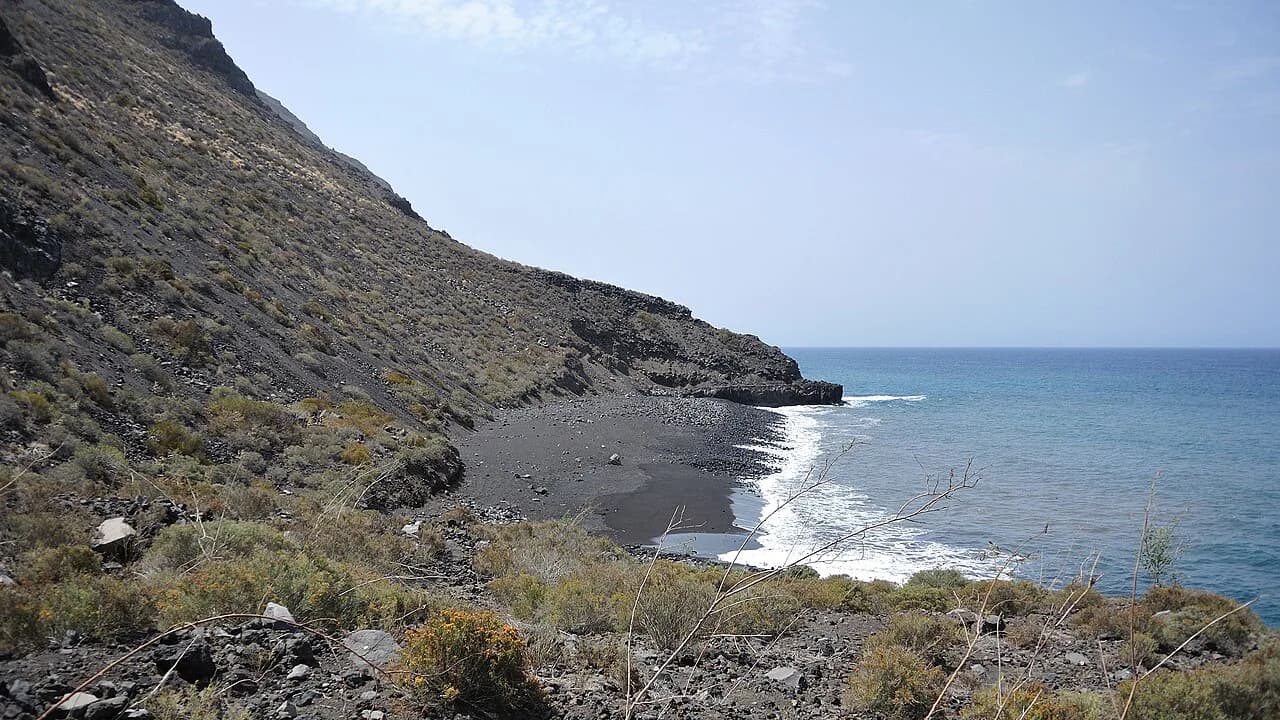
Punta Larga is a small black-sand bay just over 100 metres long on the Fuencaliente coast, formed where three lava tongues met the sea and now partly protected by a breakwater. Steps lead down to the water, parking and places to eat are nearby, and the village setting makes it an easy afternoon stop rather than a full-day destination.
Fuencaliente: Echentive, Playa del Faro and the salt pans
Playa Echentive was formed by the 1971 Teneguía eruption and stretches around 300 metres in a young lava landscape near the southern tip. It is reachable by car despite its wild look, and natural seawater pools among the rocks give some shelter when the open beach is rough; the open water itself is best left alone unless conditions suit you.
Playa del Faro lies below Fuencaliente's old and new lighthouses, a short walk from the salt pans and the marine reserve, and mixes black sand with pebbles. Services are few, so combine it with the lighthouse museum and salt pans and carry your own water and shade; the working lighthouse and the old one now used as a museum make the headland worth the detour.
East coast: Los Cancajos, Bajamar and the Santa Cruz city beach
Los Cancajos sits between the airport and Santa Cruz de La Palma, where a volcanic-rock breakwater shelters the bay and often keeps the water calmer than the west coast. The varied underwater scenery makes it the island's strongest snorkelling and diving beach, and facilities include accessible entrances, parking, public transport, showers, toilets and sunbed and sunshade rental.
Bajamar, immediately south of the capital between the marina and the Risco de la Concepción Natural Monument, runs around 700 metres of black sand and is used by local residents all year. It has accessible entrances, parking, showers and toilets, cafés nearby, and an east-facing position that makes it a sunrise beach rather than a sunset one.
Santa Cruz de La Palma's own beach opened in April 2017, restoring black volcanic sand to the Avenida Marítima on the site of the old Caleta del Varadero. Showers, toilets, sunshade rental and volleyball and football areas sit directly across the promenade from restaurants and the historic centre, which makes it the obvious choice if you are staying in town without a car.
La Salemera and the south-east fishing coast
La Salemera lies on the south-east coast at Villa de Mazo beside a small traditional fishing settlement, with a large seawater pool enclosed by coastal rocks next to the dark beach. That pool is the reason families come: it is sheltered in a way the open Atlantic beside it is not, and the difference between the two is the point.
Places to eat are available near the bay and the lighthouse forms part of its setting, so it works well as a lunch stop on a south-east circuit. Keep children in the pool rather than on the open beach when wind and swell pick up, because conditions inside the rock barrier say little about the sea beyond it.
The north: Nogales, Bujarén and the Garafía cliffs
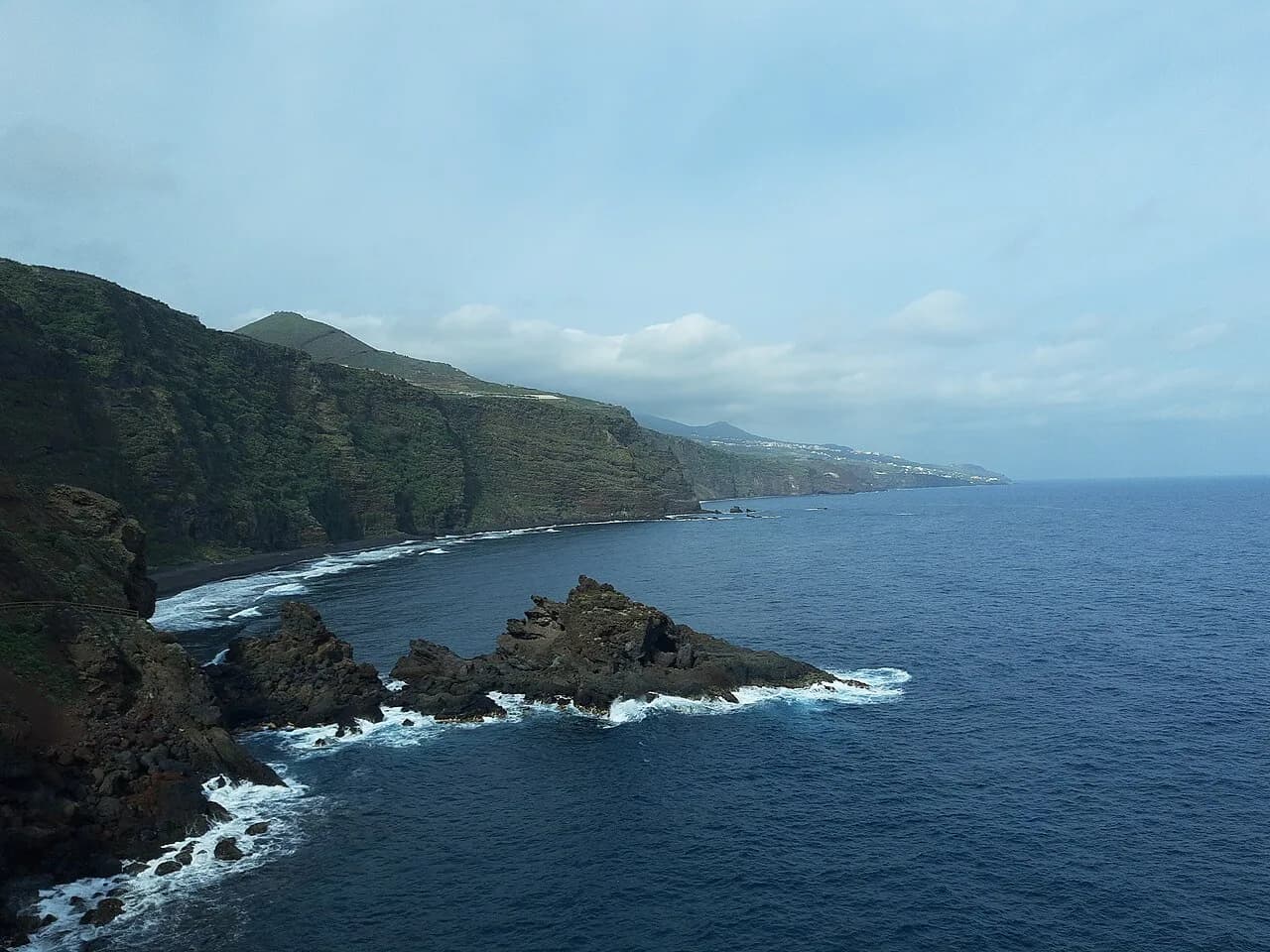
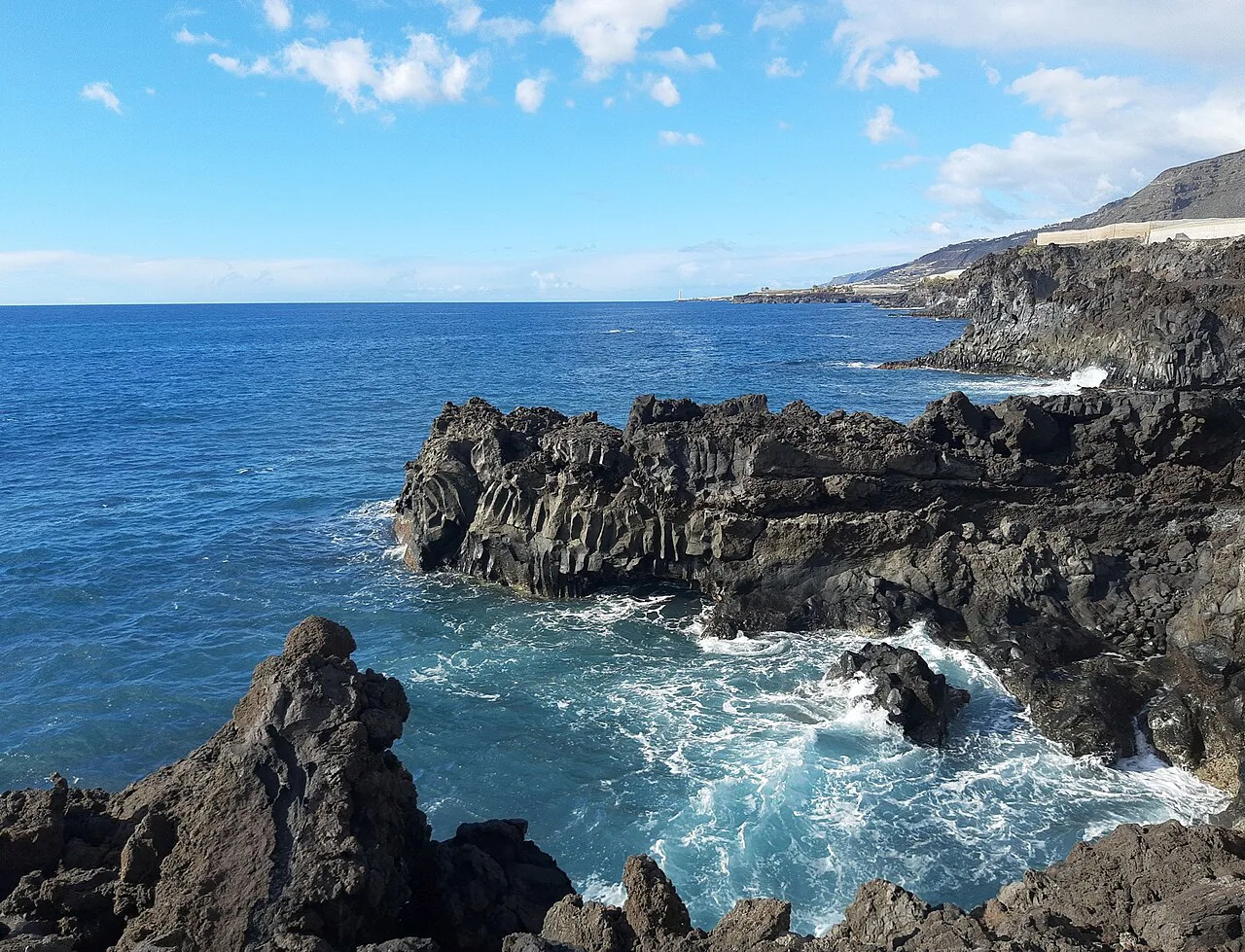
Playa de Nogales below the cliffs of Puntallana combines black sand, green slopes and open Atlantic, and is reached by a path with steps down from the car park. The climb back is moderately demanding, so travel light; the beach draws experienced surfers, and the currents and breaking waves make it a place to watch rather than swim when the sea is unsettled.
Bujarén, beneath the Garafía cliffs, is smaller and more serious: it is reached only on foot along a steep, demanding path or from the sea, and black sand may collect in the cove in summer while at other times it is mainly stony. Sure footing, proper shoes, enough water and an honest assessment of the climb back are essential before you start down.
Natural seawater pools: Charco Azul, Puerto Espíndola and La Fajana
On the coast of San Andrés y Sauces, Puerto Espíndola is a small dark cove beside the fishing harbour, and a few minutes away Charco Azul offers several natural seawater pools protected from the direct surf by coastal rocks. Good access, sun decks, showers, toilets and places to eat make the complex convenient for families, though waves can overtop the barriers in heavy seas and closures must be respected.
La Fajana on the Barlovento coast works on the same principle: several basins continually refreshed with Atlantic seawater, sheltered by rock barriers, with different depths and an accessible section, plus showers, toilets, sun terraces and a restaurant. The pools can close for safety during heavy seas even when the water inside looks calm, so treat a closure as a signal about the ocean rather than an inconvenience.
Beaches for families with small children
Tazacorte is the most straightforward family beach on the island: long, black-sanded, backed by a promenade with bars and restaurants, and sheltered by a breakwater that reduces currents and waves. Charco Verde is the quieter alternative, with ramps, walkways, showers, toilets and a small bar, though some services run seasonally.
For water that is enclosed rather than merely sheltered, the pools at Charco Azul and La Fajana give children a defined edge to play within, with sun decks and facilities alongside. La Salemera's rock-enclosed pool offers the same advantage on the south-east coast, with the fishing village and its restaurants a short walk away.
Beaches for swimmers, snorkellers and surfers
Swimmers should look at Los Cancajos first: the breakwater takes the edge off the swell and the rocky underwater scenery rewards anyone with a mask. Puerto Naos is the west-coast counterpart, where the black reef suits snorkelling and a promenade of bars and restaurants sits a few steps from the sand.
Surfers gravitate north to Nogales, where the sea is reported as fairly rough and boards can be rented from a shack on the beach, and to La Zamora, where suitable swells draw surfers to the cove below the car park. Neither is a beginners' setting or a swimming beach on a big day, so match your plans to the forecast rather than to the guidebook.
Blue Flag status is worth treating as a dated label rather than a permanent one: five La Palma beaches held the award in 2019, with Los Cancajos and Tazacorte among those named. Look up the current national list before you build a day around the flag.
Getting around by bus, car and on foot
A car makes the cliff beaches possible: Nogales, La Zamora, Punta Larga and Bujarén all depend on parking above or near the cove, and Bujarén requires a steep walk either way. If you are staying in Santa Cruz without a car, the city beach is on the promenade and Bajamar and Los Cancajos are short hops along the east coast.
Buses reach the main west-coast resorts, and the beach at Tazacorte has a bus stop close to the sand, though services to smaller coves such as Charco Verde may be seasonal. Check the island transport operator's timetable for the day you plan to travel rather than assuming a summer service runs in spring or autumn.
When to go: sea temperatures, wind and busy months
The sea is at its most comfortable from late spring through early autumn, and the west coast around Puerto Naos and Tazacorte is the sunniest and most sheltered side of the island. August is the busiest month on the resort beaches, while the cliff coves in the north stay quiet year-round because access limits the numbers.
Wind direction decides which coast works on a given day: when the west is exposed, the breakwater beaches of Los Cancajos and Bajamar on the east are often the better bet. Build a flexible plan around two bases rather than committing to one beach for the whole week.
Nearby beaches to combine on one day out
On the west coast, Puerto Naos, Charco Verde and Tazacorte sit within a short drive of each other, so you can start in the shade of the palms at Puerto Naos, move to the enclosed cove at Charco Verde and finish with sunset on the Tazacorte promenade. Fuel and food are easiest to find at either end of that sequence. If you enjoy comparing resort beaches like these, the Alcudia beaches guide shows how a similar mix of long sand and sheltered coves is organised around one base.
On the east, pair Santa Cruz's city beach with Bajamar and Los Cancajos in a single run along the coast, ending with a snorkel where the breakwater holds the water. In the south, link Echentive and Playa del Faro with the lighthouses and salt pans for a half-day that mixes swimming with a walk.
In the north, Nogales can be combined with the pools at La Fajana and Charco Azul for a day that starts with a cliff descent and ends with sheltered bathing, which is useful when the open Atlantic is unsettled. It is a long drive, so start early and carry supplies, because services at Nogales are limited to a surf shack.
Safety on La Palma's beaches
Several of the island's most striking beaches are unsupervised, including La Zamora, Punta Larga, Echentive, Playa del Faro and Nogales, where currents and breaking waves can be strong. Read the flags, watch how the water behaves for ten minutes before you commit and keep children within arm's reach at the edge.
Respect eruption-related barriers on the west coast. Puerto Naos remains under CO₂ monitoring, and the lava delta formed in 2021 is not open to visitors without explicit authorisation.
At the natural pools, closures during heavy seas apply even when the basins look inviting, because waves can overtop the rock barriers. If a gate is shut or a sign posted, move on to a breakwater beach such as Los Cancajos instead of waiting it out on the rocks.
Plan Your Beach Days
Choose your coast by the forecast and your group by the access: Tazacorte and Los Cancajos for easy family days, Puerto Naos for snorkelling and a promenade, Nogales and Bujarén for a hard walk to a wild cove, and Charco Azul or La Fajana when the open Atlantic is too rough for comfortable swimming.
Confirm transport and any pool or beach closures with the island transport operator or the local tourist office before a long drive, and carry water, shade and footwear suitable for steps. The beaches reward the preparation.
Explore more La Palma beaches
Frequently Asked Questions
Is La Palma worth visiting for beaches?
Yes, if you want variety rather than a single long resort strip. The west coast around Tazacorte and Puerto Naos gives you black-sand beaches with promenades, bars, accessible entrances and, at Tazacorte, a breakwater that reduces currents and waves. The east around Los Cancajos offers a sheltered bay that is the island's best bet for snorkelling, and the north has cliff-foot coves such as Nogales that reward a stepped descent. Add the natural seawater pools at Charco Azul and La Fajana and you have somewhere to bathe even when the open Atlantic is rough.
Are all the beaches in La Palma black sand?
Nearly all of them, because the island is volcanic. The texture varies: some coves are fine black sand, others are pebbles or bare rock, and Bujarén can hold black sand in summer while being mainly stony at other times. The dark colour comes from the volcanic material, not from dirt, and the olivine crystals at Puerto Naos give the sand a greenish tint in places. Bring reef shoes for the cliff beaches, where rock and shingle are harder on bare feet than soft sand.
Which La Palma beach is best for families?
Tazacorte is the easiest choice: a long black-sand beach backed by a promenade with bars and restaurants, sheltered by a breakwater that cuts down currents and waves, with accessible entrances, parking and a bus stop nearby. Charco Verde, south of Puerto Naos, is a smaller cove with ramps, walkways, showers, toilets and a beach bar, though some services run seasonally. For enclosed water rather than merely sheltered water, the pools at Charco Azul and La Fajana give children a defined edge to play within, with sun decks, showers and toilets alongside.
Which beach in La Palma is best for surfing?
Nogales, below the cliffs of Puntallana, is the established surfing beach, with a reputation for rough sea and a shack on the sand where boards can be rented. La Zamora, one of the two coves below Las Indias, also draws surfers when the swell suits. Both are unsupervised and have strong currents or breaking waves on the wrong day, so they suit experienced surfers rather than beginners or families, and you should judge conditions from the car park before descending.
How many Blue Flag beaches are there in La Palma?
Five La Palma beaches held Blue Flag status in 2019, with Los Cancajos and Tazacorte among those named. The award is reviewed each year, so treat that figure as a dated snapshot rather than a current total, and look up the national Blue Flag list for the year you are travelling before you build a day around a specific beach.
Which beaches near Santa Cruz de La Palma are worth a day?
The capital has two: the city beach on the Avenida Marítima, reopened in 2017 with showers, toilets, sunshade rental and volleyball and football areas, and Bajamar just south of town, around 700 metres of black sand with accessible entrances, parking, showers and toilets. Los Cancajos lies a short run along the east coast between the airport and Santa Cruz, with a volcanic-rock breakwater that often keeps the water calmer and underwater scenery that suits snorkelling and diving.
Can you swim at Playa de Nogales?
Nogales is unsupervised, and the currents and breaking waves can be strong, so swimming depends on the day rather than the beach. The sea is often rough enough to attract experienced surfers, and the access is a stepped path down from the car park with a moderately demanding climb back. When the sea is unsettled, enjoy it from the sand or from a safe position on shore, and watch how the water behaves before going in.
Are there natural seawater pools in La Palma?
Yes, in two main places. Charco Azul, on the coast of San Andrés y Sauces near the Puerto Espíndola fishing harbour, has several pools protected from the direct surf by coastal rocks, with sun decks, showers, toilets and places to eat. La Fajana on the Barlovento coast has several basins refreshed with Atlantic seawater, different depths and an accessible section, plus a restaurant. Both can close for safety in heavy seas, and waves can overtop the rock barriers.
Sources
Beach notes for your next trip
Optional updates when we add or revise beach guides.
You might also like
Continue reading
More guides you'll find useful