Platja de Sant Sebastià, Sitges: Beach Day Guide
Plan a day at Platja de Sant Sebastià in Sitges: how to get there by train, bus or car, the sand and water, lifeguard hours, facilities and nearby beaches.
On this page
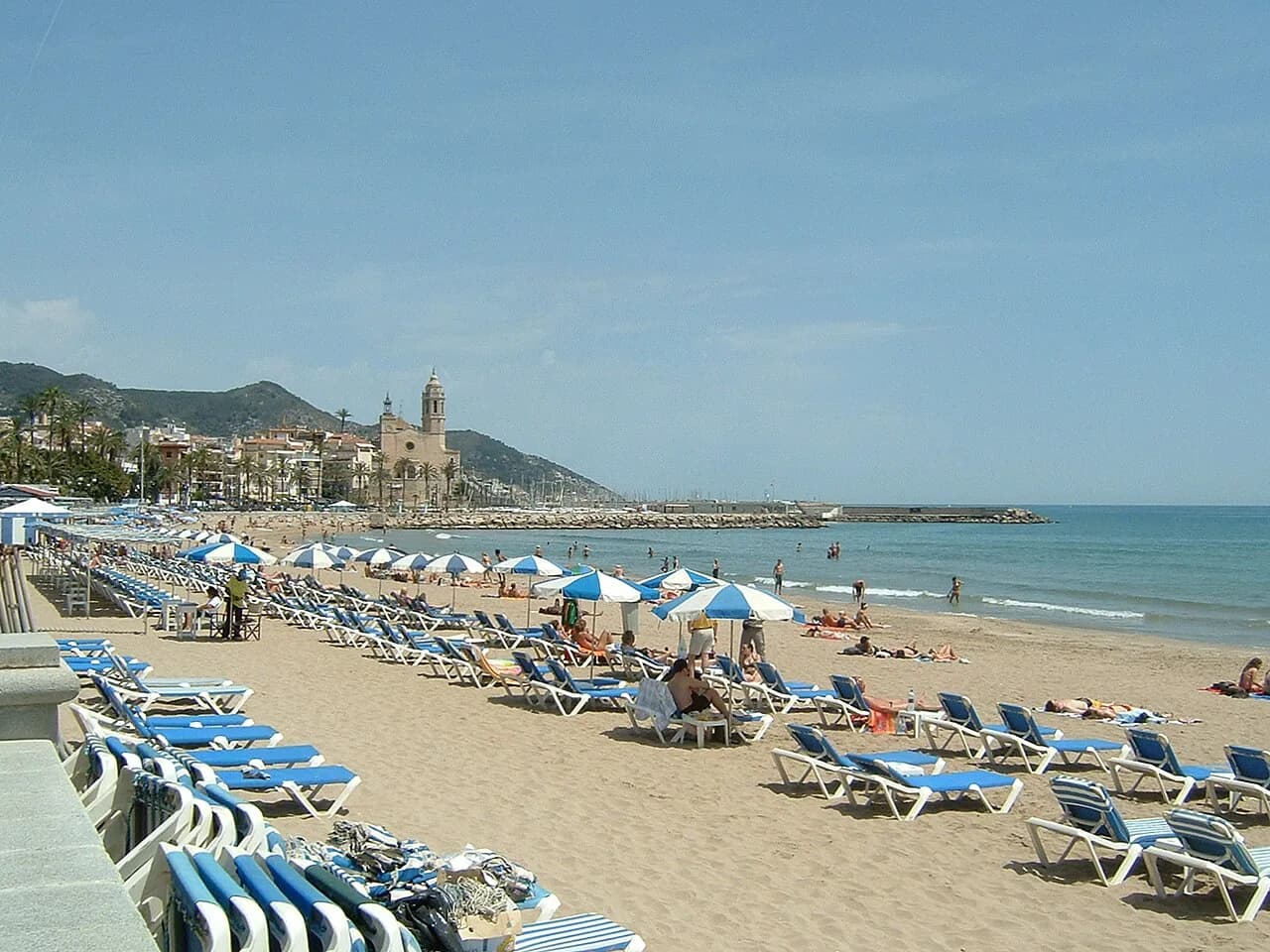
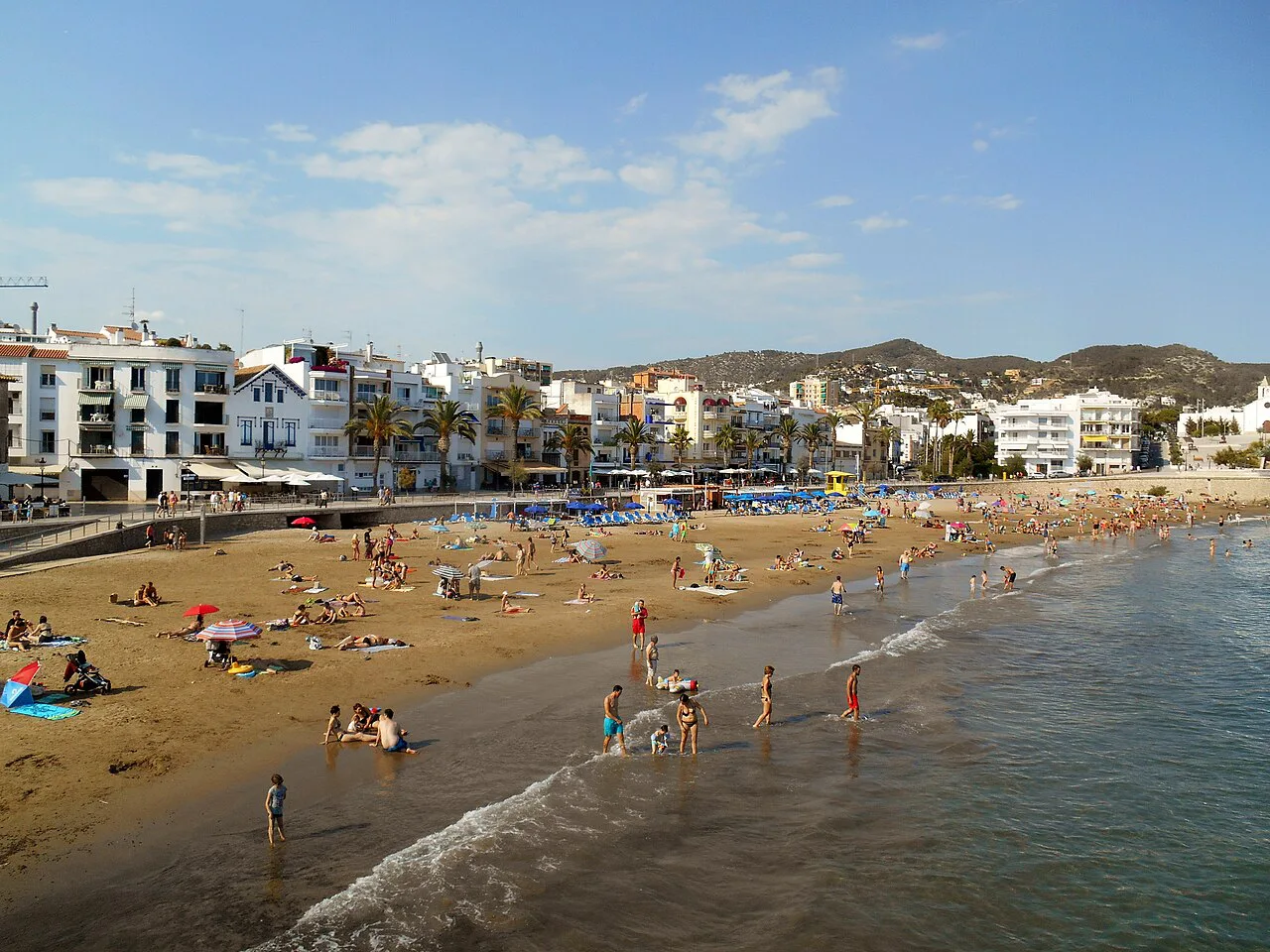
Platja de Sant Sebastià makes an easy first swim in Sitges: a 205-metre town beach with the church of Sant Bartomeu rising above the rooftops and the old town lanes a few steps behind you. It suits families with young children, older swimmers who want a short walk from the station, and anyone who prefers a beach with shops and bars within reach rather than a remote cove. Arrive in the morning for a spot near the water, or late afternoon when the day-trippers thin out and locals come down for an evening dip.
Where the beach sits
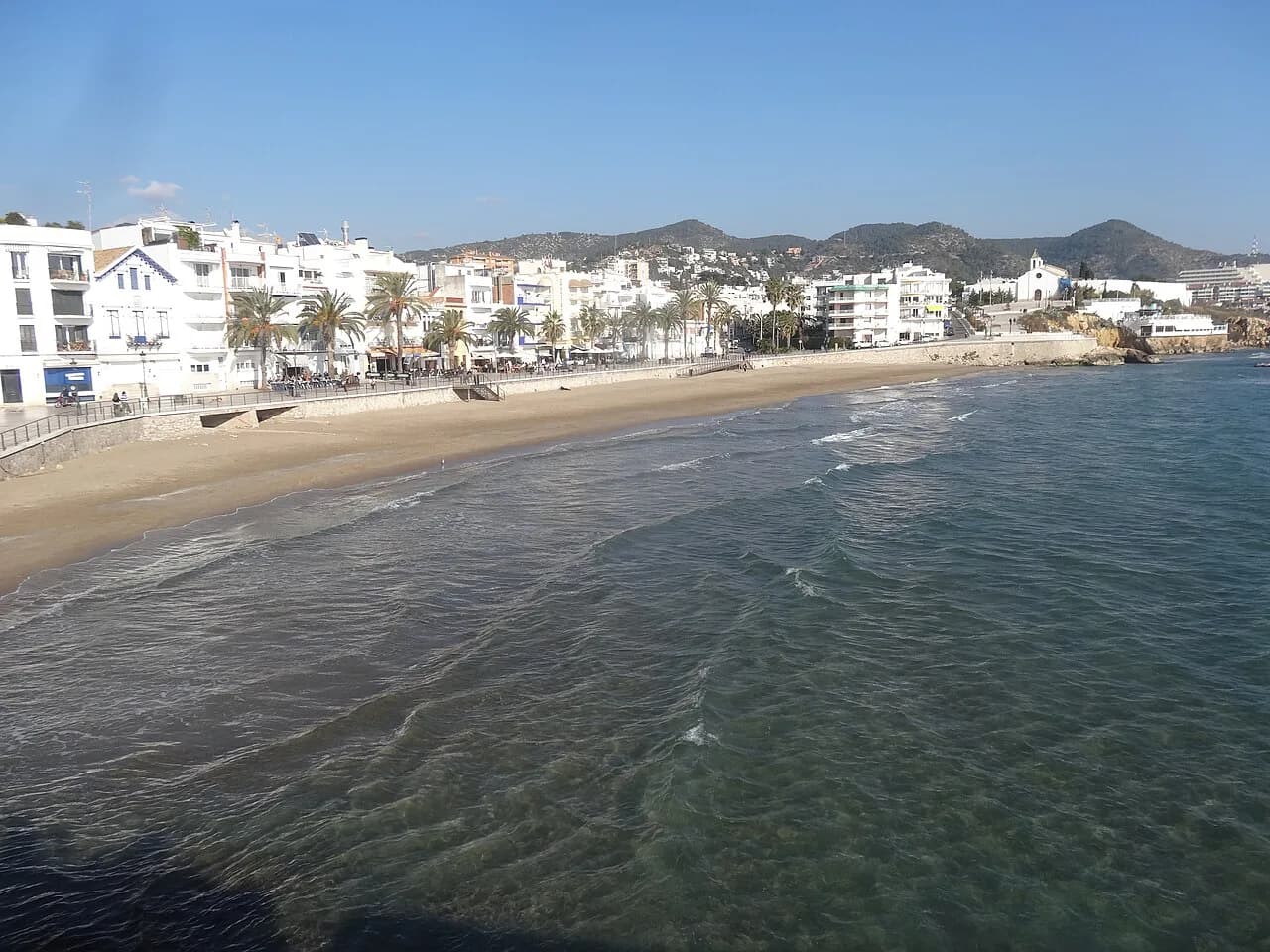
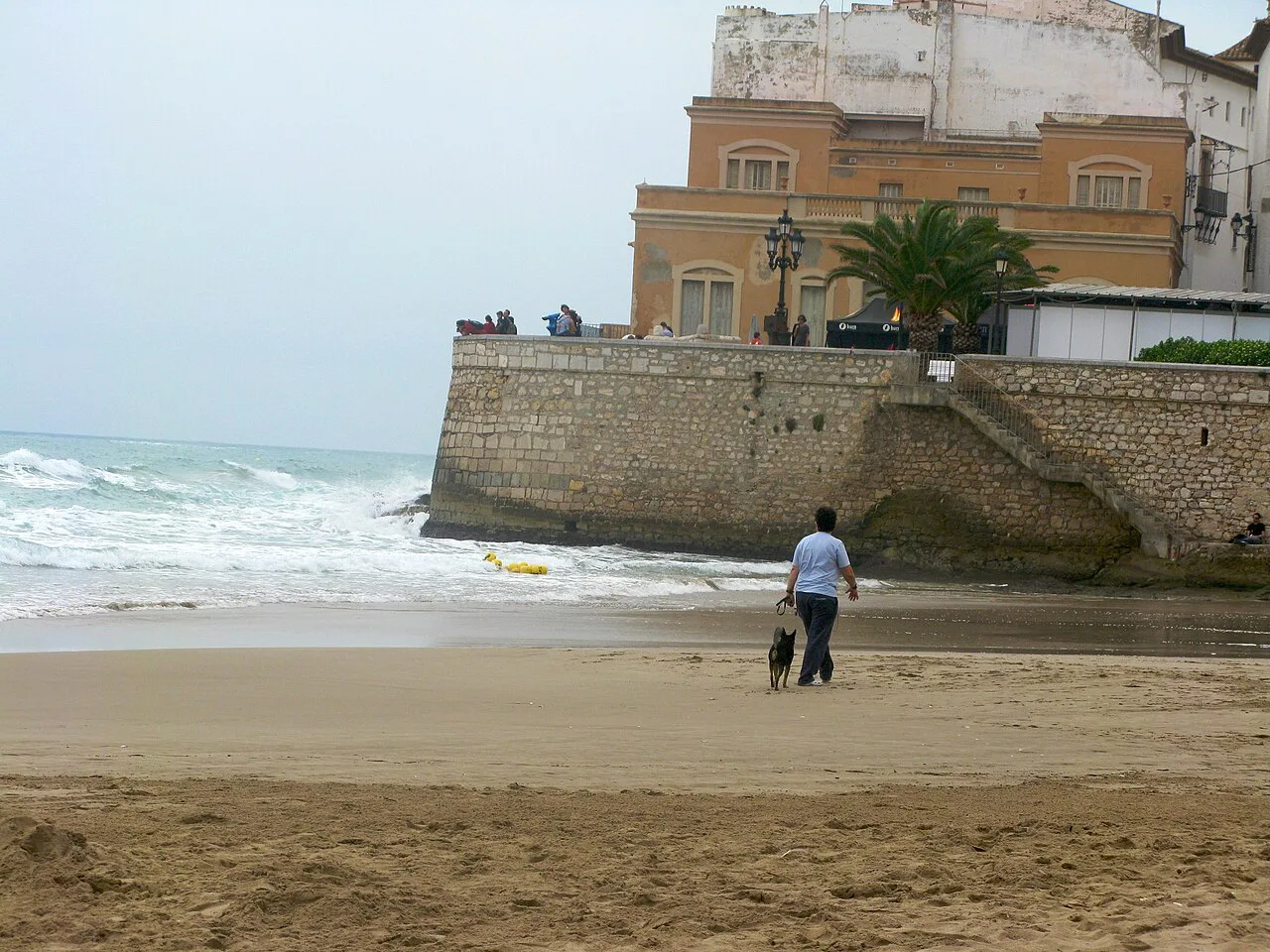
The beach forms the eastern end of the Sitges seafront, with the old town at its back and the Mediterranean in front. Sitges Turisme defines its limits as the children's playground and Avinguda dels Balmins to the east and Baluard Vidal i Quadras to the west, which makes it straightforward to find: walk the seafront promenade east from the church square and you are on it. The position is the point of the beach. You can swim, dry off and be in the old town for lunch within minutes, which is why it fills with local families as much as visitors.
Getting there
The train is the simplest option from Barcelona and the airport: Sitges station sits about 400 metres from the sand, a short walk down to the seafront. BusGarraf runs the Barcelona–Sitges line along the C-32 motorway and stops at Parc de Can Robert, from where the beach is a few minutes on foot. A local urban bus stops 25 metres from the beach, useful if you are staying on the edge of town or carrying children and bags.
By car, leave the C-32 at the Sitges Centre exit; the C-31 from Castelldefels and the B-211 from Vilafranca del Penedès both feed into town. Parking near the front is blue-zone street parking, so bring coins for the meter and expect the closest spaces to go early on summer weekends. If you are weighing up a car day against the train, the train wins on summer weekends: no parking hunt, no meter, and the station is closer to the sand than most car parks.
The sand and the water
Sitges Turisme lists the beach at 3,615 square metres across a 205-metre length, with a bathing zone marked out over 200 metres. It is a compact town beach rather than a long sweep, so it reads busy quickly in August and feels sociable rather than wild. The bay is open to the sea, and the tourism office publishes a daily sea state alongside the flag colour, so a breezy day can mean more movement at the water's edge than a calm one.
Families tend to settle near the children's playground at the eastern end, where the sand meets Avinguda dels Balmins and the walk back to the promenade is shortest. Swimmers who want a longer, quieter stretch head west towards Baluard Vidal i Quadras, away from the playground traffic. Bring water shoes if you plan to explore the rocks at the edges of the bay, and shade of your own, since the middle of the beach is open to the sun for most of the day.
Facilities
The published facilities cover the basics well for a town beach: three WCs and three showers, four pedal-boat hire points and wooden walkways laid for people with reduced mobility. There is also an amphibian chair, which lets a wheelchair user get from the promenade to the water with assistance. Sitges Turisme also lists the beach as smoke-free, so leave the cigarettes at the apartment.
Sitges Turisme records a Blue Flag, an ISO 14001 environmental certificate, the Biosphere certification and EMAS registration for the beach, and it flies a bathing flag with information panels at the entrances. Dogs are prohibited, as the signs at the beach state. For pedal boats, sunbeds and any lido service, ask at the hire points on the sand on the day; the tourism office does not publish rates.
Lifeguards and flags
Lifeguard cover follows a published seasonal timetable from a first-aid tower on the beach. For the 2026 season it ran from 12:00 to 18:00 over Easter (28 March to 6 April), 10:00 to 18:00 from 1 to 24 June, 10:00 to 19:00 from 25 June to 31 August, 10:00 to 18:00 from 1 to 27 September, and 11:00 to 18:00 from 28 September to 12 October. Outside those dates, swim with the flag and your own judgement in mind, and check the season's hours with Sitges Turisme before you rely on cover early or late in the year.
Best time to go
Sitges Turisme reported a sea temperature of 25°C and an air temperature of 25°C on one October day, which shows how mild the water stays into autumn; treat that as a reading, not an average. July and August are the busiest months, when the beach fills with local families and day-trippers and the pedal boats are all out. June and September give you warm water with more space, and the lifeguard hours in those months still cover the main swimming day.
Mornings are the calmest time for a swim before the beach fills, and evenings after the day-trippers leave are when the town comes down to the water. Jellyfish presence is reported on the tourism office's daily beach status page, so glance at it before you set out with children. For a full picture of the town's other beaches and how they compare, see the Sitges beaches guide.
Nearby beaches
You do not need to choose between Sant Sebastià and the rest of the town. Platja de la Ribera and Platja de la Fragata sit along the same seafront towards the church, so you can walk from one to the next in a few minutes and pick the spot that suits the wind. Both are town beaches in the same mould, backed by the promenade and handy for a coffee or an ice cream between swims.
If you want a change of scene, Garraf beach sits a short train ride down the coast at Garraf village, with a cove setting below the cliffs that feels a world away from the town front. Further west, Castelldefels beach offers a long, broad sweep of sand for a full day out, with more space to spread out when Sitges is packed. Both make sensible second-day trips once you have done the town beaches. If you are heading up or down the coast anyway, the Tarragona beaches make a natural comparison for a longer swimming day.
Practicalities for a beach day
Pack for a town beach: towels, water, a sun hat and your own shade if you want it, plus cash or a card for the blue-zone meter. The walkways and amphibian chair are there for anyone who needs them, and the showers and WCs mean you can rinse off and head straight into town. Sitges Turisme publishes the daily flag, water temperature, sea state and jellyfish status on its beach page, which is worth a look before you leave your accommodation for the day.
Dogs and the beach rules
One question visitors often raise is whether they can bring a dog onto the sand at Platja de Sant Sebastià. The beach's own information panels address this directly: the signposting listed for the beach includes Senyals de prohibició de gossos, meaning signs prohibiting dogs, alongside the bathing flag, the information panels for the beach's services and the safety buoys at the breakwaters. So a dog is not permitted on this beach, and the prohibition is displayed on site as part of the same signage system that marks the balisada 200 m swimming area.
For anyone planning a day here with a dog, that rule is worth weighing against the layout of the beach itself. Platja de Sant Sebastià is described as a family beach where you share space with the people of the town, with a maritime tradition like the neighbourhood it sits in. It has a surface of 3615 m² and a length of 205 m, bounded to the east by the Parc infantil and Av. dels Balmins and to the west by the Baluard Vidal i Quadras. There are 200 m of balisada marking, 3 WCs, 3 showers, 4 rentapeus, blue-zone parking and a train station 400 m away, and it is a smoke-free beach. None of these facilities is presented as a dog area.
If you are working out how a dog fits into a beach day, the practical points in the beach's listings are what you can rely on: the signage about dogs, the location of the beach between the Parc infantil and Av. dels Balmins to the east and the Baluard Vidal i Quadras to the west, and its position as an entry or exit point for visiting the old town. The lifeguard and rescue service operates from one immediate-intervention point of the "torre sitgetana" type, with hours that vary by season, from 12 to 18h during Setmana Santa (28/03 to 06/04) up to 10 to 19h between 25/06 and 31/08. Plan your walk around those hours and the on-site dog prohibition, and keep the dog off the sand.
Walking the promenade with a dog
Because the sand itself is off limits to dogs, the natural alternative for a dog walker is the promenade that wraps around Platja de Sant Sebastià. The beach runs 205 metres along the front and its eastern limit is marked by the Parc infantil and Av. dels Balmins, while its western limit is the Baluard Vidal i Quadras, so the paved walk beside it connects the old quarter with the stretch towards Balmins. On the promenade you will find many restaurants and cafes where you can eat or have a drink, which makes a slow loop with the dog easy to combine with a stop. The beach itself is described as the most familiar beach in Sitges, usually frequented by local people, and it sits right next to the Church of Sitges, also called the Punta de Sitges, so a promenade walk keeps you within sight of the church of Sant Bartomeu.
One detail worth pointing out to anyone walking a dog along this front: the promenade holds a piece of the La Concha railing, a twinning between the two beaches inaugurated by the mayor of San Sebastián in September 2009, with a plaque reading “San Sebastián and Sitges, two film cities in love with the sea and culture”. Very close to it stands the Hotel San Sebastià Playa, which has 51 rooms and privileged views; on its ground floor there is a door presided over with a sailboat on a blue background, similar to the Donostia coat of arms. None of this requires entering the sand, so the dog stays on the walk beside you while you take it in.
For timing, bear in mind how the beach's own services run through the season, since the front is busiest when the lifeguards are on duty. The single lifeguard and rescue point, a tower of the type known as a “torre sitgetana”, operates from 12 to 18 h during Setmana Santa (28/03 to 06/04), from 10 to 18 h from 1/06 to 24/06, from 10 to 19 h from 25/06 to 31/08, from 10 to 18 h from 1/09 to 27/09, and from 11 to 18 h from 28/09 to 12/10. The beach is marked with signs prohibiting dogs, and it is a smoke-free beach, so the promenade is the place to keep your dog while the sand stays a no-go zone.
Plan Your Visit
Platja de Sant Sebastià is the beach to choose when you want a swim without a trek: a short walk from the train, the old town behind you, the church in view and a marked bathing zone in front. Go early in summer, aim for the eastern end with young children, and check the day's flag and sea state before you set out.
Frequently Asked Questions
Is Platja de Sant Sebastià good for families with young children?
Yes, it is a strong choice for families. The eastern end has a children's playground and the walk from the promenade to the sand is short. The beach is a compact 205 metres with a marked 200-metre bathing zone, so children stay in view. Lifeguards work from a first-aid tower on the beach during the published seasonal hours.
How do you get to Platja de Sant Sebastià from Barcelona?
Take the train to Sitges, with the station about 400 metres from the sand. Alternatively, BusGarraf runs the Barcelona–Sitges line along the C-32 and stops at Parc de Can Robert, a few minutes' walk from the beach. By car, leave the C-32 at the Sitges Centre exit.
Is there parking near Platja de Sant Sebastià?
Parking close to the seafront is blue-zone street parking, so bring coins for the meter and arrive early on summer weekends. The beach is reached from the C-32 Sitges Centre exit, the C-31 from Castelldefels or the B-211 from Vilafranca del Penedès. The train is the easier option if you are coming from Barcelona.
When are lifeguards on duty at Platja de Sant Sebastià?
Cover follows a published seasonal timetable from a first-aid tower on the beach. For the 2026 season it ran from 12:00 to 18:00 over Easter, then through June, July, August and September with hours varying between 10:00 and 19:00, and from 11:00 to 18:00 from 28 September to 12 October. Hours change by season, so confirm the current timetable with Sitges Turisme.
Is Platja de Sant Sebastià a Blue Flag beach?
Yes. Sitges Turisme records a Blue Flag for the beach, along with ISO 14001, Biosphere and EMAS environmental certifications. It is also listed as a smoke-free beach, and dogs are prohibited according to the signs at the entrances.
How warm is the sea at Platja de Sant Sebastià in summer?
Sitges Turisme reported a sea temperature of 25°C on one October day, which reflects how mild the water stays into autumn. Treat that as a reading rather than an average. July and August are the busiest months, while June and September offer warm water with more space on the sand.
Which other beaches in Sitges are nearby?
Platja de la Ribera and Platja de la Fragata sit along the same seafront towards the church, a few minutes' walk from Sant Sebastià. Garraf beach is a short train ride down the coast, and Castelldefels beach offers a long, broad sweep of sand further west.
Sources
Beach notes for your next trip
Optional updates when we add or revise beach guides.
You might also like
Continue reading
More guides you'll find useful